The quiet impact of art in space
Sometimes we enter a room and sense a change immediately, even before our eyes settle on anything in particular. Something feels calmer, more coherent, perhaps more spacious. Without being able to consciously name it, our inner state shifts. Our breath may deepen, our thoughts slow down. This is where the impact of art begins, not only in the act of looking, but often already in quiet presence. In this blog article, you will discover how art, and original art in particular, can subtly influence spaces and moods, what role intention plays in the creative process, and why artworks accompany us even when we give them little conscious attention in everyday life.

Art works - even when we are not consciously aware of it
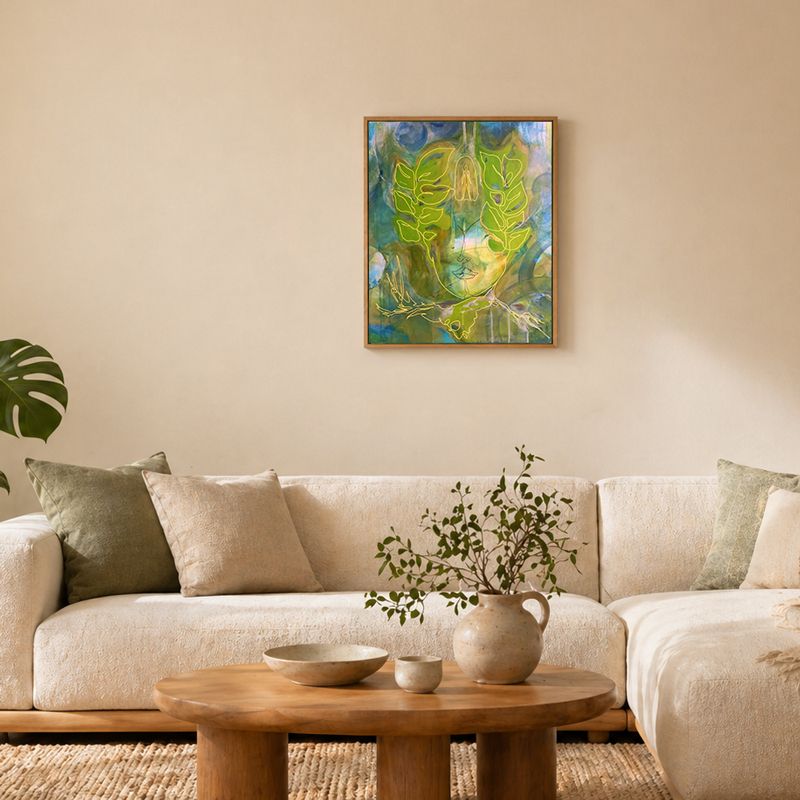
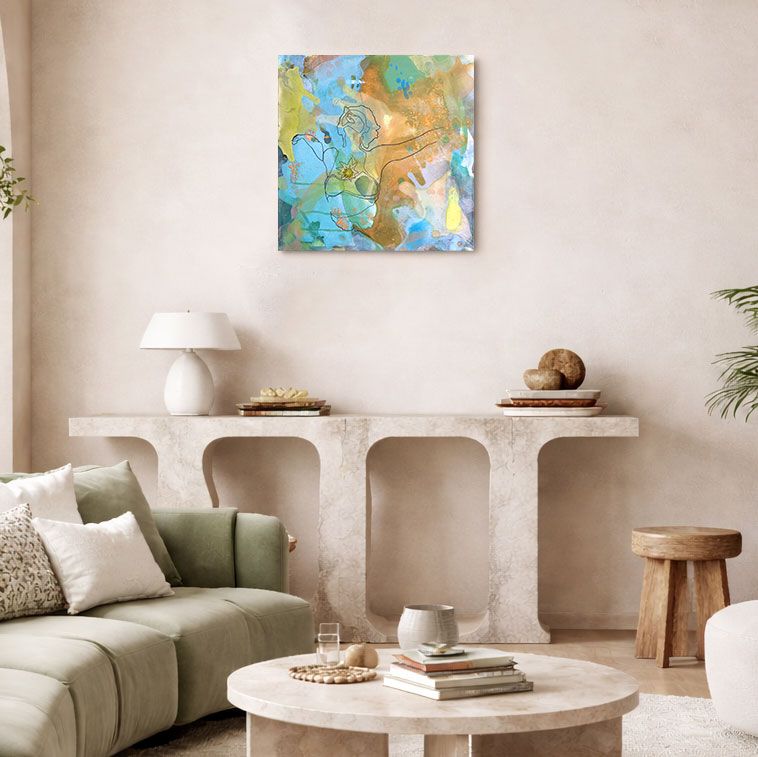
Spaces are never neutral. They carry mood, history, and energy. Light, colors, materials, and forms continuously influence us, even when we are not consciously aware of it. Art is part of this atmosphere. It does not only change the visual appearance of a room; it shapes its emotional impact.
Research in environmental and architectural psychology shows that designed spaces can influence our well-being, our ability to concentrate, and our experience of stress. Art is therefore not merely decorative, but an active element of spatial perception. A painting can open a space, calm it, or give it density.¹
Why original art has a particular depth
An original artwork is not simply “a beautiful picture.” It is a work that carries energy within it. It is the result of a process that required time, attention, and presence. Every line, every movement bears traces of its creation. This quality is not always visible but it is often tangible.
Studies suggest that people respond differently to original artworks than to reproductions. When viewing original works, stronger emotional reactions and even physiological changes, such as reduced stress levels have been measured. This indicates that originals are perceived on a deeper level, not only visually but also physically, and that our nervous system responds to their presence and energy.²
Intention – what resonates during creation
When I create a work, I always work with a clear inner orientation and attitude. My intention is to support positive emotions, to create an open and supportive atmosphere, and to bring something into a space that nourishes without demanding.
This intention is not an abstract idea, but an integral part of the creative process. It shows itself in how I work: how I place lines, how much space I allow, and how fully I permit myself to be present. During the act of creation, a quality emerges that cannot be explained but that continues to resonate within the finished work.
From research on aesthetic perception, we know that emotions play a central role. We do not respond only to forms and colors, but to the feeling they emit and awaken within us. ³ This emotional resonance often arises faster than conscious thought and regardless of whether we actively look at a work or it simply exists within the space. ⁴ This is where art unfolds its true power.
The unconscious companionship of everyday life
In everyday life, we often move through our surroundings on autopilot. We see things while our thoughts are elsewhere; we move through rooms without consciously perceiving them. And yet, we remain receptive to the different moods of our environment. An artwork created with intention does not unfold its effect only through direct viewing, but also through quiet presence.
There are moments when we suddenly notice that a space feels different, that it receives us in another way, that we are accompanied by a certain quality before we even know why. This effect does not demand interpretation, yet it remains tangible: in our breathing, in our bodily sensation, in our awareness of how we feel within a space.
Studies show that regular contact with art alone can enhance subjective well-being, not through isolated intense moments, but through a continuous, balancing effect. Art thus becomes a quiet companion, holding atmosphere and opening emotional spaces without demanding attention. ⁵

Impact without explanation
Art does not need to be understood in order to be effective. Often, its strength unfolds precisely when we stop analyzing. It may remain open, ambiguous, and quiet. Its impact does not always show itself in words, but in feeling, in the body, in the way we experience ourselves within a space.
Perhaps this is its greatest strength: art is energy and it changes something, even when we are not looking.
If these thoughts resonate with you, perhaps it is because you sense that art is more than something meant to be observed. It can become part of your living space and accompany you through emotional processes. Maybe there is a room in your life that is looking for exactly this: an artwork that lifts your energy and supports you in everyday life.
Feel free to visit the Artroom and let yourself be touched by the energy of my work. Perhaps your favorite piece is already waiting for you there.
Sources:
¹ Braden, M. & Benison, T. (2025). Wellbeing and the Arts: A Concise Survey with New Findings. Springer. S. 12–19.
² Art Fund & King’s College London (2025). First-of-its-kind study proves positive impact of art on the body. Abgerufen am 09.02.2026: https://www.artfund.org/our-purpose/news/first-of-its-kind-study-proves-positive-impact-of-art-on-the-body
³ Universität Wien (2025). Kunst in unserem Leben steigert das Wohlbefinden. Press Room Universität Wien. Abgerufen am 09.02.2026: https://www.univie.ac.at/aktuelles/press-room/pressemeldungen/detail/kunst-in-unserem-leben-steigert-das-wohlbefinden
⁴ Law, M. et al. (2021). Evidence for the effects of viewing visual artworks on stress. BMJ Open. S. 2–3.
⁵ Law, M. et al. (2021). Evidence for the effects of viewing visual artworks on stress. BMJ Open. S. 5–7.